Practice › Battles #4 and #6 · Shame and Guilt
Shame vs guilt: what's the difference?
At two in the morning they can feel identical: hot face, heavy stomach, the same scene on repeat. But they point in different directions, and knowing which one you're in changes what you do next.
This is not therapy or medical advice. If you're in the US: Call or text 988. Call 988 or Text 988.
The short version
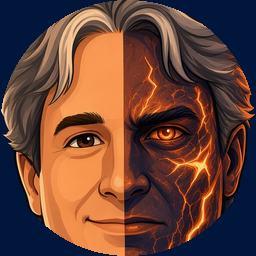
Guilt says, "I did something bad." Shame says, "I am bad."
Guilt is about a thing you did. Shame is about who you think you are. One small word, did or am, separates them, and it matters a lot, because you can do something about an action. A judgment on your whole self just sits on you.
Guilt: the quiet referee
In The Two Battles we call conscience the quiet referee. Its job is to keep the lower self, the part of you that reacts on impulse, fear or comfort, from doing damage, and to make you uncomfortable when it does anyway. Healthy guilt is that referee blowing the whistle. It usually means you care about someone, and it nudges you to go and make it right.
Guilt turns into a battle when it's bigger than what happened, when it's about something that was never yours to carry, or when it keeps going long after you've done what you could. At that point it has stopped being a nudge and started being a punishment.
Shame: feeling like the problem is you
Shame skips the action and goes straight for you. Its message is that you're the defect, and that if people saw the real you, they'd be gone. It wants you hidden and quiet. And it's good at disguises: it can look like anger, like needing everything perfect, like keeping everyone happy, or like disappearing into a screen, a bottle or your work.
How to tell which one you're in
- Listen to the sentence. "I shouldn't have said that" is guilt. "I'm such an idiot, I ruin everything" is shame.
- Notice the pull. Guilt tends to pull you toward the person: apologize, fix it. Shame tends to pull you away from everyone: hide, go quiet.
- Ask what would help. If one honest repair would ease it, it's probably guilt. If nothing you could do feels like enough, because the problem seems to be you, shame is likely in the mix.
- They often travel together. You can feel guilty about something you did and ashamed of yourself at the same time. That's normal. Start with the part you can act on.
What to do with each
For guilt: check if it's fair. Look at what actually happened, what you knew back then, and how much of it was really in your hands. If it points to a real wrong, make the smallest real repair you can, then stop. Lying awake replaying it doesn't fix anything.
For shame: change the sentence. Take the "I am" story and turn it into an "I did" or "I struggle with" story. "I'm a failure" becomes "I failed at this, and I can learn from it." You can work on what you did. You can't work on a label.
And for shame especially, let one safe person in on a small piece of it. Shame grows when it's kept secret. Being met with understanding by someone who has earned your trust is one of the most direct ways to shrink it. If no one feels safe yet, a therapist can be that person.
When to get more help
If guilt or shame is constant, is tied to trauma or abuse, or you feel like you deserve to suffer, please talk to a licensed professional. Those are exactly the situations they're there for.
Get the Sunday letter
One honest letter from Jamie every Sunday: one battle, one idea, one small practice you can try that week.
Go paid: $9.99/mo $99/yr What paid gets you
Need a calmer moment first? Play Anxiety Relief, our free calming game: a few minutes of slow breathing and grounding, with no sign-up.
Sources and further reading
Plain-language pages from established health organizations that this page is consistent with. They don’t endorse this page.
- Shame, APA Dictionary of Psychology
- Guilt, APA Dictionary of Psychology
- Raising low self-esteem, NHS
This is not therapy or medical advice. It’s peer support from someone who fights these battles too. If something here is getting in the way of your life, please talk to a doctor or licensed therapist.
If you're in the US: Call or text 988. Outside the US, use your local emergency number. You can also chat at 988lifeline.org. Outside the US: findahelpline.com.
Want the whole framework? The six battles, one chapter each, are in the ebook The Two Battles.