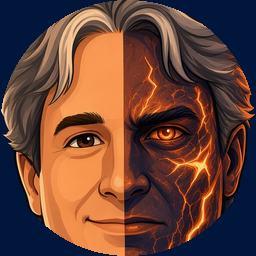
Free guide: how to win the battle inside your head
Every life is two battles: the fight with the world, and the fight within. Start with three free things: the first chapter of the book, a two-minute reflection, and five lessons you can try in a minute each.
Get the first chapter free
Enter your email to download the introduction and chapter one of The Two Battles as a PDF, right away.
Want a new lesson every Sunday? Tick the Sunday letter box above, or use the box below.
Which battle sounds familiar?
Before you start: this is a reflection, not a test. It is not a diagnosis or medical advice, and it can't tell you whether you have a mental-health condition. Seven quick questions; pick the answer that fits best, even if it only fits a little. Nothing you choose is saved or sent anywhere. It all stays on your device.
Sounds familiar: Anxiety
Your answers lean toward the anxiety battle: the voice that says stay away and you'll be safe. Stepping around what scares you brings quick relief, and then the fear gets a little bigger. The way through isn't becoming fearless. It's taking steps small enough to do while your heart is still pounding.
“Something bad will happen.” becomes “I can handle hard things.”
Sounds familiar: Sadness
Your answers lean toward the sadness battle: the voice that says stay down, nothing matters. That doesn't mean you have depression. Only a doctor or therapist can tell you that. What it does mean: the heaviness is real, it isn't laziness, and you don't have to fix your whole life today to take one small step.
“Nothing matters.” becomes “One small thing matters today.”
Sounds familiar: Pride
Your answers lean toward the pride battle. Not the good kind, being proud of work you did, but the kind that says asking makes you look weak, so you'd rather struggle alone for three hours than ask for help for three minutes. It feels like being competent. The fix isn't shrinking yourself. It's staying a student.
“Asking makes me weak.” becomes “Asking makes me stronger.”
- Watch the films on YouTube (the Pride film isn’t out yet)
- Browse all practice pages
Sounds familiar: Shame
Your answers lean toward the shame battle: the feeling that the problem isn't something you did, but who you are. Shame wants you to hide, and hiding is what keeps it going. You're not broken for feeling it, and you don't have to fight it alone.
“I'm worthless.” becomes “I'm learning.”
Sounds familiar: Anger
Your answers lean toward the anger battle: heat that shows up fast and hot, and sometimes burns the people you care about. Anger isn't a flaw. It's a signal and a source of energy. The work is learning to steer it instead of letting it drive.
“I'm losing control.” becomes “I can use this heat.”
Sounds familiar: Guilt
Your answers lean toward the guilt battle: replaying what you did or didn't do, and not being able to put it down. Some guilt is a useful nudge to make things right. Some is bigger than what happened, or isn't yours to carry. Either way, going over it again and again isn't the same as repair.
“I ruined everything.” becomes “I can repair this.”
Remember: this is not a diagnosis or medical advice. Most people fight more than one of these battles, and your answer can change week to week. If anything here has felt heavy for more than two weeks, or is getting in the way of work, sleep or the people in your life, please talk to a doctor or a licensed therapist. If you're in the US: Call or text 988. Outside the US, use your local emergency number.
This is not therapy or medical advice. If you're in the US: Call or text 988. Outside the US, use your local emergency number.
Five lessons for the battle within
Ideas from the Stoics and modern psychology for anxiety, overthinking and low motivation, each with a practice you can do in one minute. No course. No upsell. Just the tools.
Sort what's yours from what isn't
"Some things are within our power, while others are not." (Epictetus, Enchiridion 1). A lot of anxiety comes from straining against what you can't control. Your effort, choices and responses are yours. Outcomes and other people's opinions aren't.
One-minute practice: Write the worry at the top of a page. Draw a line down the middle: "Mine" and "Not mine." Pick one item from "Mine" and do the smallest piece of it today.
Come back to this moment
Marcus Aurelius told himself not to let the future disturb him: if it comes, he'd meet it with the same reason he uses on today (Meditations 7.8, paraphrased). Overthinking lives in tomorrow. You can only act in now.
One-minute practice: Name 5 things you see, 4 you can touch, 3 you hear, 2 you smell, 1 you taste. Then ask: "What is the one thing this moment needs from me?"
Check the story against the facts
"We suffer more often in imagination than in reality." (Seneca, Letters to Lucilius 13). The mind rehearses disasters that rarely arrive. Cognitive therapy calls this catastrophizing, and it weakens when you look at it.
One-minute practice: Write: "What I fear will happen." Then: "What I actually know." Then: "If it did happen, how would I cope?" Notice the gap between the first line and the second.
Name the thought, don't obey it
Acceptance and Commitment Therapy (ACT) teaches cognitive defusion: seeing thoughts as passing words, not commands or facts. You can't always stop a thought, but you can step back from it.
One-minute practice: Take your loudest thought ("I'm going to fail") and say it as: "I'm noticing I'm having the thought that I'm going to fail." Repeat it three times, slowly.
Move first; motivation follows
Waiting to "feel like it" keeps you stuck. Action tends to come before motivation, not after.
One-minute practice: Pick a task so small it feels silly: put on your shoes, open the document, wash one dish. Set a 60-second timer and start. Stopping after is allowed. Usually, you won't.
Adapted from Jamie’s free guide, How to Win the Battle Inside Your Head.
Go deeper: the practice library Watch the films
Get the Sunday letter
One honest letter from Jamie every Sunday: one battle, one idea, one small practice you can try that week.
Go paid: $9.99/mo $99/yr What paid gets you
Finished a lesson? Play Anxiety Relief, our free calming game, for a few calm minutes of breathing and grounding.
This is not therapy or medical advice. It’s peer support from someone who fights these battles too. If something here is getting in the way of your life, please talk to a doctor or licensed therapist.
If you're in the US: Call or text 988. Outside the US, use your local emergency number. You can also chat at 988lifeline.org. Outside the US: findahelpline.com.